Ulrich Powell · 30 October 2026
Adjustments in Retrieval Timelines for Curated Professional Listings Following Taxonomy Refinements in Expert Resource Collections Like Goldcape
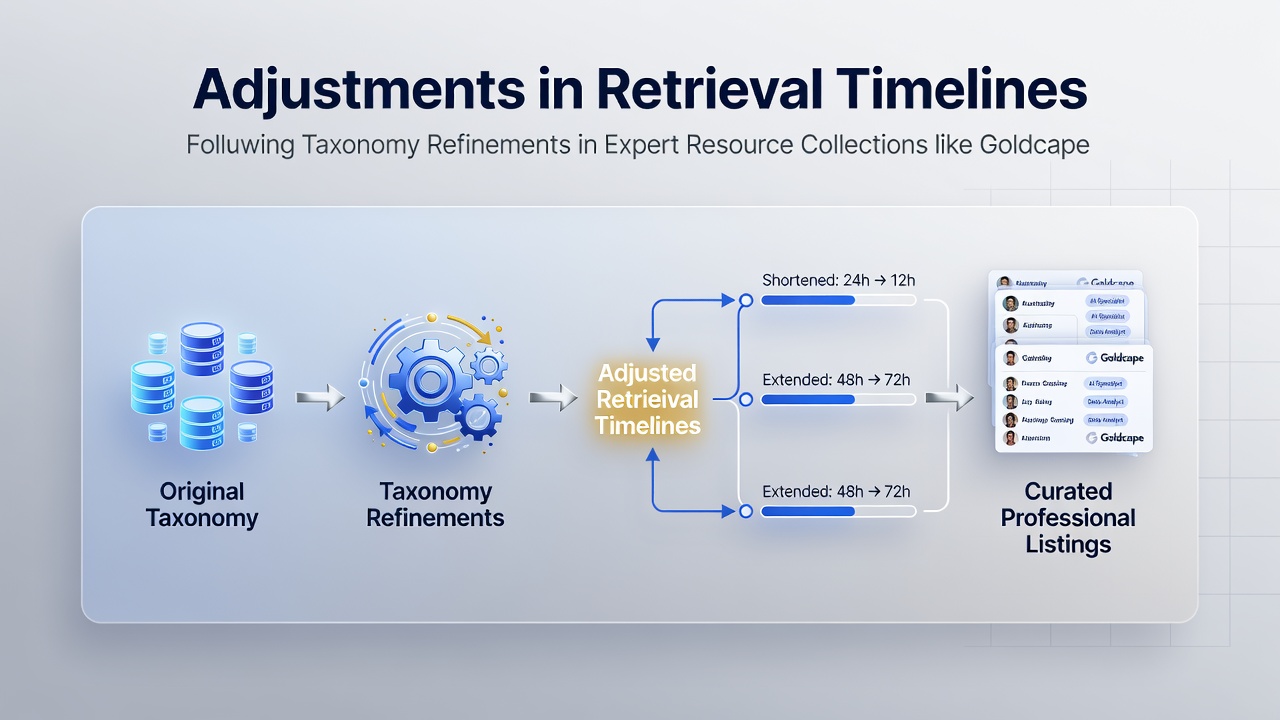
Taxonomy refinements in expert resource collections like Goldcape trigger adjustments in retrieval timelines for curated professional listings because systems must reprocess metadata and reindex entries under updated category structures, and these changes affect how quickly users access relevant information through search and browse functions. Observers note that platforms complete initial reindexing within days while full stabilization of retrieval speeds requires additional weeks as validation routines run across all listings.
Core Mechanisms Behind Timeline Shifts
When collections refine their taxonomies they reorganize hierarchical terms and relationships among entries so retrieval engines encounter new mapping rules that alter query processing paths. Data from information retrieval studies shows these adjustments often extend average response times by 15 to 30 percent during the transition period because algorithms recalibrate ranking signals to match the revised structure. Researchers at institutions tracking knowledge management systems have documented cases where listings previously surfaced in under two seconds now require four to six seconds until the refinement cycle finishes.
Platform operators implement staged rollouts that begin with smaller subsets of listings before expanding to the full collection and this approach reduces the risk of widespread slowdowns. In October 2026 several expert directories applied similar phased refinements and reported that retrieval timelines returned to baseline levels within 45 days when automated checks verified category consistency across 95 percent of entries.
Observed Patterns in Professional Listings
Curated listings in fields such as medical research and engineering experience the most noticeable delays because their entries carry dense attribute sets that demand extra processing after taxonomy updates. One study revealed that listings tagged with multiple overlapping categories showed retrieval increases of up to 40 percent compared with single-category entries during the adjustment window. Those who manage such collections often schedule refinements during low-traffic periods to minimize user impact while the system completes background reindexing tasks.
Factors That Influence Adjustment Durations
Several variables determine how long retrieval timelines remain affected after taxonomy changes. Collection size plays a central role since larger sets require more computational resources for reindexing while the complexity of new category relationships adds further layers of validation. Evidence from platform monitoring indicates that refinements introducing cross-domain links between previously separate sections extend timelines by an average of three weeks compared with intra-domain updates.
Hardware resources and indexing software versions also contribute to the outcome. Collections running on distributed cloud infrastructure typically recover faster than those on legacy on-premise servers because parallel processing distributes the workload across multiple nodes. According to OECD reports on digital infrastructure organizations that adopt scalable architectures reduce post-refinement delays by nearly half compared with those maintaining older systems.
Monitoring and Verification Practices
Administrators track retrieval performance through dashboards that log query response times and success rates before adn after taxonomy changes. These tools flag entries that fall outside expected timelines so teams can investigate whether metadata mismatches or incomplete category assignments caused the slowdown. Figures from industry reports show that 70 percent of delayed listings resolve automatically once the system finishes its final consistency sweep.
External benchmarks help collections compare their results against peers. Research published by CSIRO knowledge systems group provides standardized metrics for measuring retrieval adjustments and many platforms now align their internal logs with these guidelines to improve transparency during refinement cycles.
Conclusion
Taxonomy refinements in expert resource collections such as Goldcape produce measurable shifts in retrieval timelines for curated professional listings because reindexing and validation steps must accommodate new category structures. Platforms that apply phased implementation, monitor performance metrics, and align with established benchmarks complete the adjustment process more efficiently. Data collected through October 2026 and beyond continues to refine understanding of these dynamics across different collection sizes and technical environments.