Ulrich Powell · 13 November 2026
Investigating Profile Interconnections Within Specialized Professional Archives Using Graph Theory Approaches
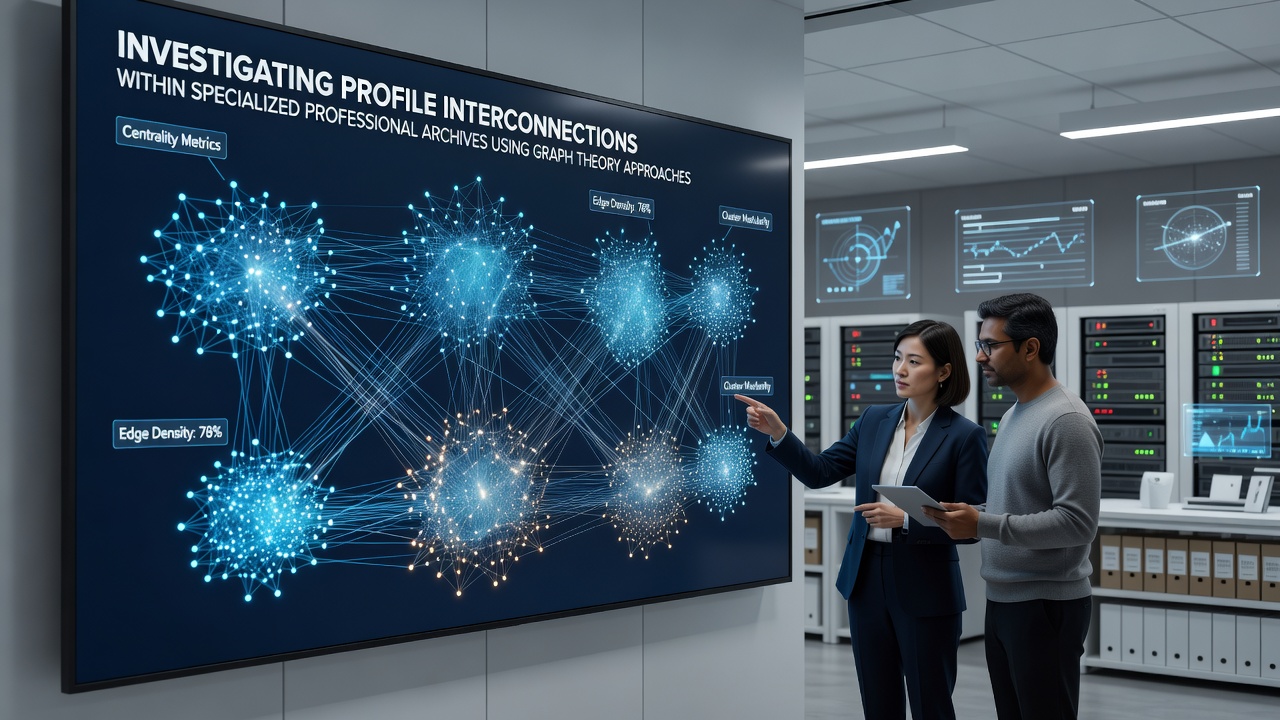
Specialized professional archives store detailed records of experts across fields such as engineering, medicine, and academia, and researchers apply graph theory to map how these profiles connect through shared affiliations, publications, or project histories. Nodes represent individual profiles while edges capture relationships like co-authorship or institutional overlap, and this structure allows systematic analysis of network properties including centrality and clustering. Data from these archives often arrives in structured formats that convert directly into graph models without extensive preprocessing.
Core Concepts Behind Graph Modeling of Profiles
Graph theory provides mathematical tools for examining large collections of professional data, where each profile becomes a vertex and documented interactions form directed or undirected edges depending on the relationship type. Degree distribution reveals how many connections a typical profile maintains, while betweenness centrality identifies profiles that act as bridges between otherwise separate groups. Observers note that these measures help surface influential figures in a given domain without relying on manual review of every record.
Community detection algorithms partition the graph into subgroups based on dense internal connections, and researchers have applied methods like Louvain or Leiden to archives holding thousands of entries. Such partitions often align with real-world specialties or geographic clusters, which supports targeted queries for collaboration opportunities. Studies from institutions in Canada have demonstrated that these techniques scale efficiently when archives exceed 50,000 profiles.
Data Preparation and Algorithm Selection
Preparation begins with extracting attributes such as education history, employment timelines, and publication lists from archive entries, then encoding them as edge weights or node features. Missing values receive imputation through similarity metrics derived from available attributes, and duplicate profiles merge via record linkage procedures that compare string distances and temporal overlaps. Once the graph exists, analysts choose between static snapshots for one-time studies and dynamic models that track edge additions over successive archive updates.
Algorithms drawn from network science literature handle specific questions effectively. PageRank variants rank profile importance according to incoming connections from other high-ranking nodes, and shortest-path calculations locate potential intermediaries between two experts. Those who have studied these approaches report that hybrid methods combining topological features with attribute similarity yield higher precision when identifying hidden interconnections.
Applications in Archive Analysis
Organizations managing professional directories use graph-based queries to detect redundant listings or to recommend experts for review panels. In one documented workflow, an archive administrator modeled co-membership in technical committees as edges and then isolated clusters that indicated emerging subfields. This process surfaced previously overlooked specialists whose profiles sat at the periphery of larger communities.
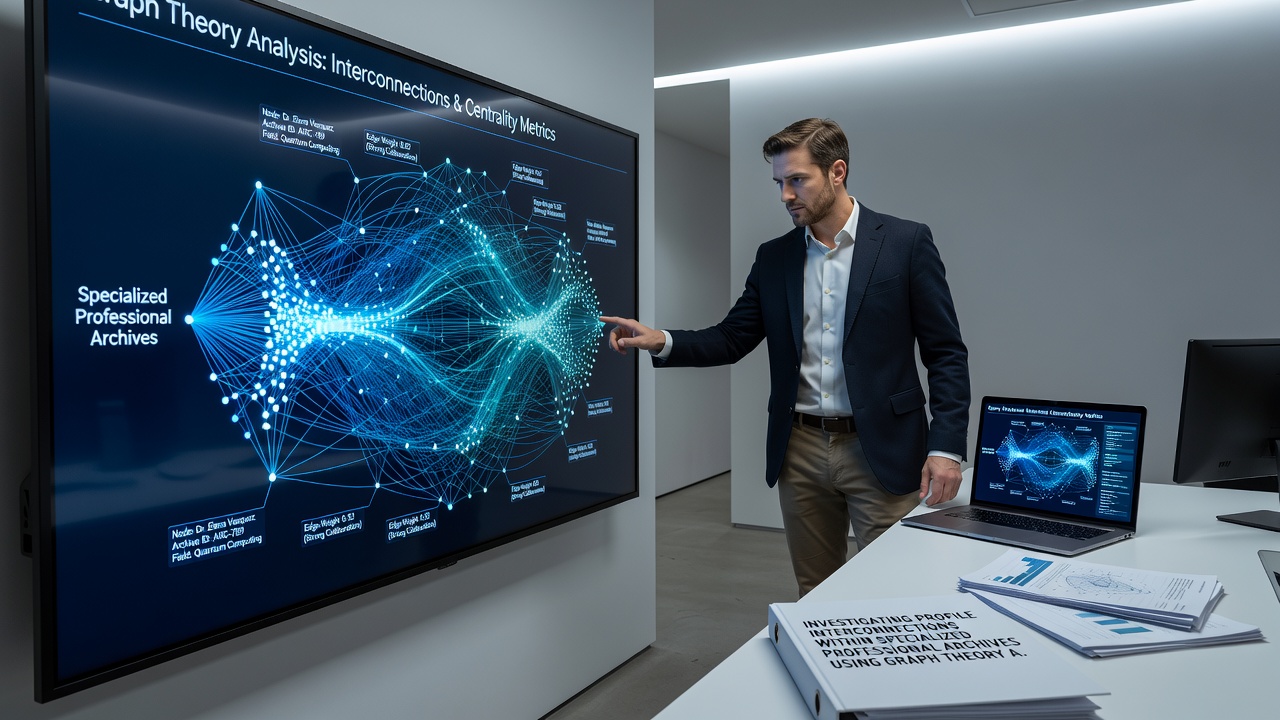
Academic research groups have integrated these graphs with temporal layers to observe how connections evolve after major events such as conference mergers or funding program launches. Figures from an Australian National University project covering archives updated through late 2025 showed measurable increases in cross-institutional edges following category consolidations. Analysts continue to monitor similar patterns as new data arrives in November 2026.
Scalability and Computational Considerations
Large archives demand efficient storage formats such as adjacency lists or graph databases that support rapid traversal. Distributed frameworks allow parallel computation of metrics across clusters of machines, and incremental update strategies avoid full recomputation when only a fraction of profiles change. Memory requirements grow with edge density, yet sampling techniques preserve key statistical properties while reducing resource use.
Privacy regulations in multiple jurisdictions require that any derived graph either anonymizes node identities or restricts access to aggregate statistics. Implementations therefore separate raw identifiers from the graph structure during processing, and access logs track queries that could reconstruct individual trajectories. These safeguards maintain compliance while still permitting network-level insights.
Evaluation Metrics and Validation
Validation compares algorithm outputs against ground-truth labels when available, such as known research groups or verified collaboration records. Precision and recall scores quantify how well detected communities match documented affiliations, and modularity values assess partition quality independent of external labels. Researchers cross-check results with smaller manually curated subsets to confirm that automated findings align with domain expertise.
Performance benchmarks typically measure runtime against graph size and report memory consumption for different density levels. Public repositories maintained by European research consortia provide standardized test graphs derived from real professional archives, enabling consistent comparison across implementations.
Conclusion
Graph theory supplies a rigorous framework for uncovering structural patterns within specialized professional archives, and ongoing refinements in algorithms and data handling continue to expand its utility. Archives that adopt these methods gain clearer visibility into profile relationships while respecting computational and regulatory constraints. Future updates scheduled for November 2026 and beyond will likely incorporate additional temporal and multimodal features to further enhance analysis accuracy.